

Ever looked at your cat and wondered why she's a swirl of orange and black, why your neighbor's tabby has those perfect racing stripes, or why almost every orange cat you've ever met seems to be a boy? You're not imagining it. Behind every coat is a surprisingly elegant genetic story, and thanks to a landmark discovery in 2025, we finally understand one of its biggest mysteries.
At The Animal Doctors of Orange County, we love the science of the pets we care for. So let's pull back the fur and look at what's really going on.
What actually gives a cat its color?
Every cat coat color you've ever seen comes down to just two pigments.
The first is eumelanin, which produces black and brown tones. The second is pheomelanin, which produces red, orange, and cream tones. That's it. Every tuxedo cat, every ginger tabby, every smoky gray beauty is simply a different recipe using these two ingredients, controlled by a handful of genes that decide which pigment gets made, how much, where it lands, and how it's arranged.
Think of it like mixing paint from two base colors. The genetics just determine the proportions and the pattern.
Why does my cat have stripes? The secret tabby gene
Here's something that surprises most cat owners: nearly every cat is secretly a tabby.
The agouti gene controls whether individual hairs are banded with color. When it's active, each hair gets alternating light and dark bands, creating the classic tabby look, whether that's mackerel (thin stripes), classic (bold swirls), spotted, or ticked. When the agouti gene is switched "off," the banding disappears and you get a solid-colored cat.
But the tabby pattern never truly leaves. Look closely at a solid black cat in bright sunlight and you can often see faint "ghost stripes." And here's a fun one to test at home: all orange cats show tabby markings, no exceptions. There's no such thing as a truly solid orange cat, because the orange pigment gene doesn't respond to the "off" switch the same way. That's why every ginger cat has at least faint stripes somewhere.
Why are most orange cats male? (And the 2025 discovery that solved it)

If it feels like most orange cats are boys, that's because they are, roughly three out of four. The reason lives on the X chromosome, and for over a century scientists knew the orange gene was there without knowing exactly what it was. In 2025, they finally found it.
The gene that makes cats orange is called ARHGAP36, and researchers led by Stanford Medicine identified the mutation and published their findings in Current Biology in May 2025. What they discovered is remarkable: orange cats carry a small deletion in a non-coding, regulatory stretch of DNA that abnormally switches on the ARHGAP36 gene inside pigment cells, where it's normally silent. Even more striking, this exact mutation appears to exist in no other mammal on Earth. It's uniquely feline.
Because this gene sits on the X chromosome, inheritance follows the sex of the cat:
- Male cats have only one X chromosome, so a single copy of the orange mutation makes them fully orange. One "hit" is all it takes.
- Female cats have two X chromosomes, so they need the mutation on both to be completely orange, which is far less common.
That single genetic quirk explains the ginger gender gap, and it's also the key to one of the most beautiful coats in the cat world.
What makes a cat a tortoiseshell or calico?
Tortoiseshells and calicos are living mosaics, and they're almost always female.
Remember that females have two X chromosomes. Early in development, every cell randomly switches one X chromosome off for good, a process called X-inactivation. If a female cat has the orange mutation on one X and the non-orange version on the other, then some patches of her skin express orange while others express black or brown, depending on which X stayed active in that region.
The result:
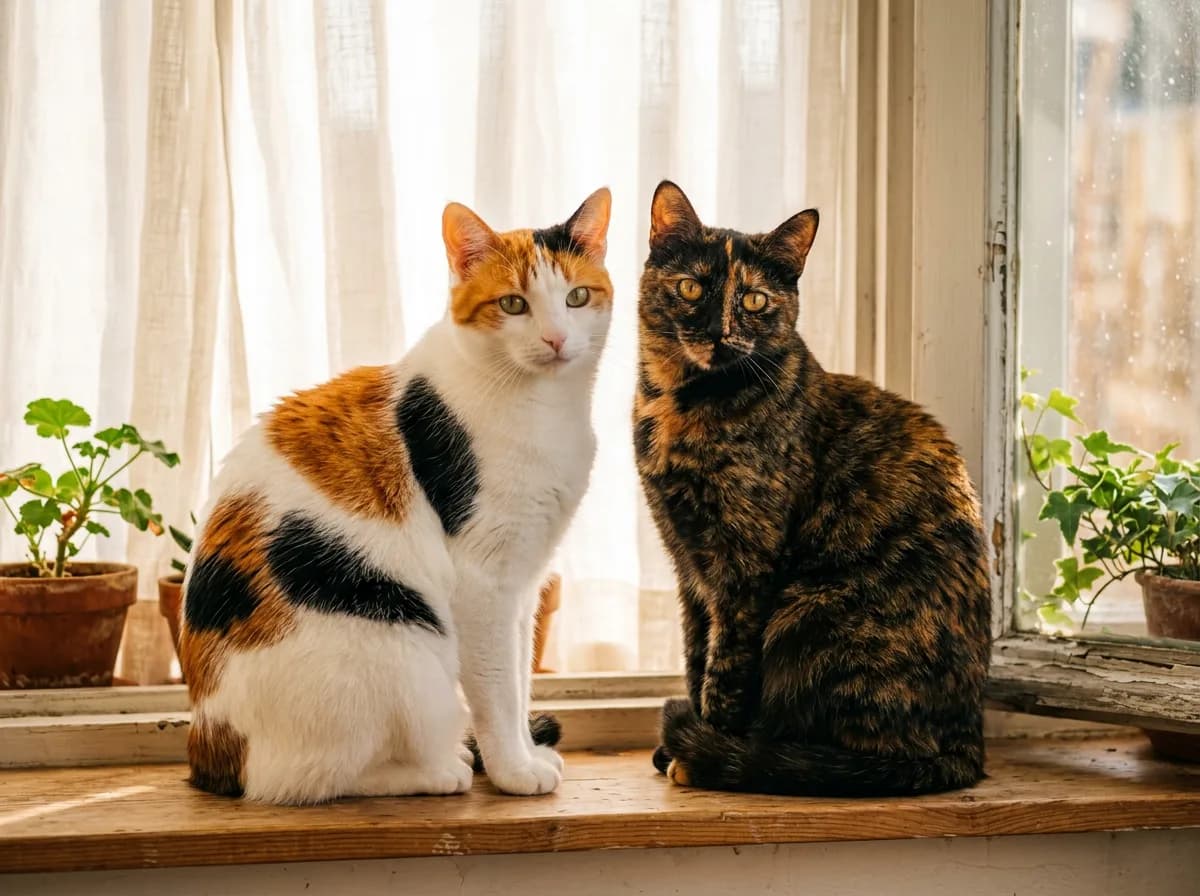
- Tortoiseshell cats show a marbled blend of orange and black (or their diluted versions, cream and gray).
- Calico cats show the same orange-and-black patches plus distinct areas of white, thanks to a separate white-spotting gene.
Because it takes two different X chromosomes to create the mosaic, torties and calicos are overwhelmingly female. On the rare occasion you meet a male tortoiseshell, he almost always has an extra X chromosome (an XXY combination), which usually leaves him sterile. If you have a male calico or tortie, you're looking at roughly a one-in-three-thousand rarity.
Why are some cats gray, blue, or cream? The dilution gene
A gray cat isn't a different color so much as a softened one.
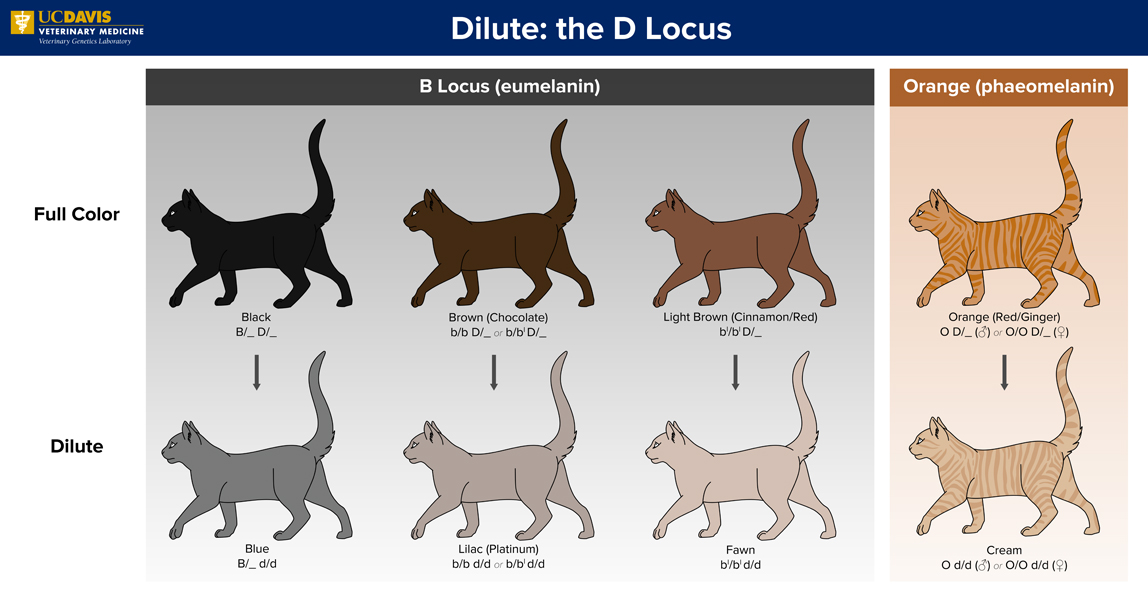
The dilution gene takes a base color and lightens it by changing how pigment granules are spaced along each hair. When two copies of this recessive gene are present, the pigment clumps unevenly, so the eye perceives a paler shade:
- Black becomes blue (the soft slate-gray you see in Russian Blues and Chartreux).
- Chocolate brown becomes lilac.
- Orange or red becomes cream.
So a "cream" cat is really a diluted orange cat, and a "blue" cat is really a diluted black cat. Same recipe, gentler volume.

What about white cats and white markings?
White works differently from every color we've discussed, because white isn't a pigment at all, it's the absence of one.
There are two separate genetic stories here. White spotting (the piebald gene) creates patches of white by preventing pigment cells from reaching certain areas of the body as the kitten develops. This is what gives you tuxedo cats, "mittens," and the white splashes on a calico. A little spotting makes a locket; a lot of it makes a mostly white cat.
Solid white, on the other hand, is caused by a dominant masking gene that essentially paints over whatever color the cat would otherwise have been. Underneath, that white cat still genetically carries a color, it's just hidden.
One health note worth knowing: the dominant white gene is linked to deafness, especially in white cats with blue eyes. If you have a blue-eyed white cat, it's worth mentioning at your next wellness exam so we can check their hearing. A deaf cat can live a perfectly happy life, but knowing helps you keep them safe, particularly around driveways and open doors.
Why do Siamese cats have dark points?
Siamese, Himalayan, and other "colorpoint" cats have one of the most fascinating tricks in feline genetics: their color is controlled by temperature.
These cats carry a form of temperature-sensitive albinism. The enzyme that produces their pigment only works properly in cooler parts of the body, so color develops on the extremities that run a little colder, the ears, face, paws, and tail, while the warmer core of the body stays pale. It's why colorpoint kittens are born almost entirely white and gradually "develop" their points over their first weeks of life. It's also why a colorpoint cat living in a chilly climate often grows darker over the years, and why a cat that's had fur shaved for surgery may grow that patch back in a temporarily darker shade before it evens out.

Frequently asked questions about cat coat colors
Are all orange cats male?
No, but most are. Because the orange gene is carried on the X chromosome, males need only one copy to be orange, while females need two. About 75–80% of orange cats are male.
Can a cat be truly solid orange with no stripes?
No. All orange cats display some degree of tabby markings, even if they're faint. The orange pigment gene doesn't fully hide the underlying tabby pattern.
Why are almost all calico and tortoiseshell cats female?
Because their mixed color pattern depends on having two X chromosomes, one carrying orange and one not. Males, with a single X, normally can't produce the mosaic unless they have a rare extra X chromosome.
Does a cat's coat color affect its personality?
There's a lot of folklore here (the "sassy tortie," the "goofy orange boy"), but scientific evidence linking color to personality is weak and inconsistent. Environment, socialization, and individual temperament matter far more than fur color.
Does coat color affect a cat's health?
Mostly no, with one notable exception: white cats with blue eyes have a higher likelihood of congenital deafness. Very pale and white cats are also more prone to sunburn and skin cancer on the ears and nose, so limit their direct sun exposure.
The bottom line
Your cat's coat is a genetic fingerprint, a two-pigment palette arranged by a handful of clever genes and, in the case of orange cats, a mutation so unusual that it exists nowhere else in the animal kingdom. It's one more reminder that even the most familiar pet is full of hidden wonders.
At The Animal Doctors of Orange County, your pet is our priority, from their coat to their whiskers to their wellbeing. If you have questions about your cat's health, skin, or coat, book a wellness exam or contact our team; our staff would love to talk with you. And don't forget to follow us on social media for more pet stories and science.
References and further reading
- UC Davis Veterinary Genetics Laboratory — Feline Coat Color
- Kaelin et al., Current Biology (May 2025) — ARHGAP36 and orange coloration in cats
- Sci.News — Genetic Mutation Responsible for Orange Coat in Domestic Cats
- Cornell Feline Health Center — White Cats and Blindness/Deafness